

micro-community-banner
 
  • Saved
GOLD 2025: Evolving COPD care through biomarkers, precision strategies, and early intervention

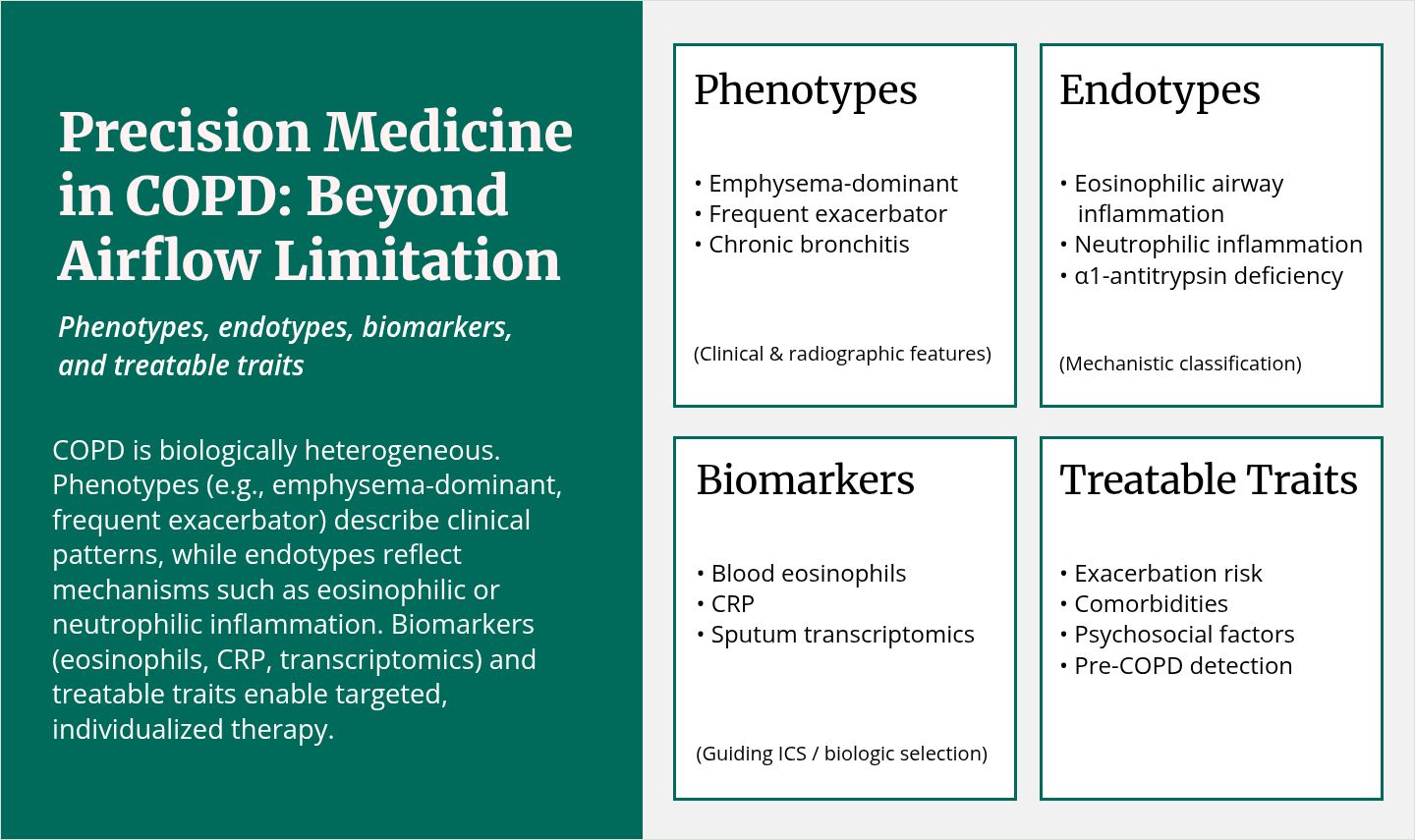
COPD management is evolving toward precision strategies that are focused on reducing exacerbations, improving lung function, and slowing disease progression. GOLD 2025 emphasizes identifying type 2 inflammation—commonly via blood eosinophil count (BEC)—to guide personalized treatment.

ICS-based therapy is more effective in patients with elevated BEC. GOLD advises considering ICS when BEC is >100 cells/μL and strongly recommends it at ≥300 cells/μL. For patients at high risk of exacerbations, triple therapy (inhaled corticosteroid [ICS] / long-acting β₂-agonist [LABA] / long-acting muscarinic antagonist [LAMA]) provides greater benefit over dual combinations, with consistent reductions in exacerbation rates and mortality.

Beyond inhaled therapy, novel agents such as PDE4 inhibitors and biologics targeting inflammatory pathways are under evaluation. These aim to address persistent symptoms and frequent exacerbations, aligning with biomarker-guided precision medicine.

Earlier identification of high-risk individuals supports a shift to proactive care. The concept of low disease activity (LDA)—defined by the absence of exacerbations, symptom worsening, or lung function decline—is emerging as a practical goal in COPD management. This evolving treatment paradigm encourages the routine use of biomarkers and timely, targeted interventions to achieve long-term stability.

How can eosinophil-guided strategies be routinely implemented to personalize inhaled therapy in COPD? What steps are needed to embed earlier, targeted interventions into COPD guidelines and care pathways?

  • Saved
Underutilization of palliative care in advanced COPD and heart failure: associations, disparities, and the role of specialists - PubMed

Underutilization of palliative care in advanced COPD and heart failure: associations, disparities, and the role of specialists - PubMed

Source : https://pubmed.ncbi.nlm.nih.gov/40796380/

Palliative care utilization is alarmingly low among patients with HF and COPD despite significant symptom burden. Specialists should advocate for PCU as their involvement could enhance end-of-life care planning, improve...

This study reveals alarmingly low palliative care use in advanced COPD and heart failure. Specialist involvement, including pulmonologists, improves patient awareness, end-of-life planning, and outcomes, underscoring the need for greater advocacy and integration.

  • Saved
Optimizing COPD Treatment: Prioritizing LAMA/LABA Therapy for Stable Patients

The 2025 GOLD report reinforces the importance of LAMAs (Long-Acting Muscarinic Antagonists) and LABAs (Long-Acting Beta-Agonists) as key components of maintenance therapy for most COPD patients, particularly for non-high-risk patients with low eosinophil counts (<300 cells/µL). These recommendations emphasize initiating LAMA/LABA combinations early in treatment to prevent disease progression and reduce exacerbation risks, while de-escalating from ICS-containing regimens when appropriate.

For stable COPD patients with infrequent exacerbations, focusing on LAMA/LABA therapy offers an effective approach to long-term disease management, aligning with evidence that supports minimizing ICS use in low-eosinophil populations. This shift prioritizes maintenance therapies tailored to patient profiles, ensuring better adherence and reduced side effects.

Preventive strategies, such as vaccination against respiratory infections, including RSV, play a critical role in managing stable COPD patients, supporting a comprehensive approach to improving outcomes and slowing disease progression.

How are you incorporating LAMA/LABA therapies into your COPD management strategies? What approaches have you found most effective for optimizing maintenance therapy in stable patients?

  • 5mo
    I regularly use combo bronchodilators for patients with copd and persistent dyspnea. They are particularly effective for patients without a history of exacerbations. I do regularly evaluate lab work to Show More
  • 6mo
    I utilize LAMA/LABA therapies regularly in my patients with COPD who are not having frequent exacerbations or have significant eosinophilia. I will typically use them in both GOLD A Show More

Show More Comments

  • Saved
Cell viability measured by cytotoxicity assay as a biomarker of chronic obstructive pulmonary disease exacerbation: a prospective cohort study - PubMed

Cell viability measured by cytotoxicity assay as a biomarker of chronic obstructive pulmonary disease exacerbation: a prospective cohort study - PubMed

Source : https://pubmed.ncbi.nlm.nih.gov/40770259/

Acute severe exacerbation of chronic obstructive pulmonary disease (COPD) is related to high mortality; however, a robust blood biomarker for COPD exacerbation has not been established. Impaired clearance of apoptotic...

Low serum cell viability, measured via LDH cytotoxicity assay, predicts increased risk of COPD exacerbations and mortality—highlighting its potential as a novel blood-based biomarker for disease progression.

  • Saved
Parametric estimation of age-, sex-, and spirometry grade-specific mortality in a cohort of COPD patients from Germany: Results from COSYCONET - PubMed

Parametric estimation of age-, sex-, and spirometry grade-specific mortality in a cohort of COPD patients from Germany: Results from COSYCONET - PubMed

Source : https://pubmed.ncbi.nlm.nih.gov/40744284/

Based on our findings, mortality in COPD depends on GOLD grade, age, sex and smoking status. Parametric estimation allowed to estimate 1-year mortality for each combination of COPD grade and...

German cohort study estimates age-, sex-, and GOLD grade-specific mortality in COPD using parametric models. Findings confirm GOLD grade and age as strong mortality predictors, supporting risk stratification in care.